

Workplace First Aid Training UK: The Definitive 2026 Compliance Guide

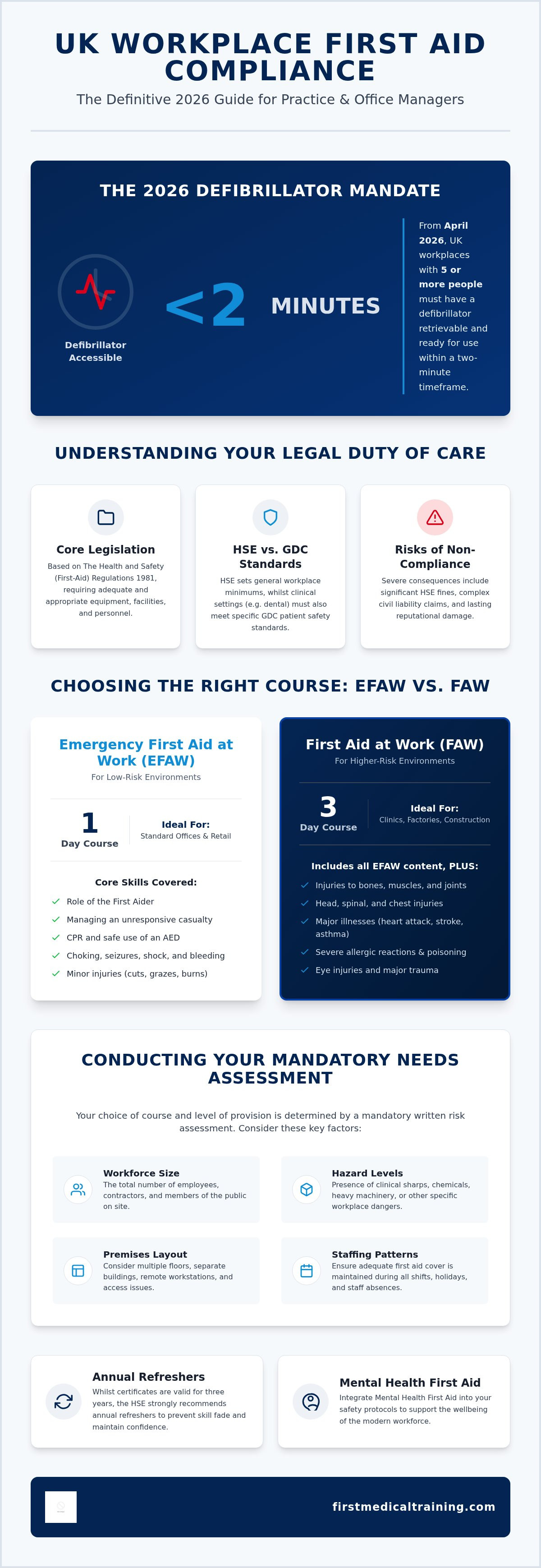
Did you know that as of April 2026, any UK workplace with five or more people is now expected to have a defibrillator retrievable and ready for use within just two minutes? This shift reflects a broader move towards more rigorous, risk-based safety standards that can feel overwhelming to even the most seasoned practice manager. You likely feel the pressure to ensure every staff member is prepared, yet the distinction between different course types often remains a source of frustration.
It's a common challenge to find workplace first aid training uk that balances basic regulatory requirements with the high-level clinical expertise your environment demands. This definitive guide will clarify exactly what you need to achieve full HSE and GDC compliance in 2026. We'll break down the latest mandatory written risk assessment rules, compare EFAW versus FAW pathways, and explain why clinical-grade instruction is the only way to build a truly confident team. By the end, you'll have a clear roadmap to mastering your legal obligations whilst providing your staff with the life-saving skills they deserve.
Key Takeaways
- Understand the mandatory shift towards risk-based assessments and how the 2026 updates impact your legal duty of care.
- Identify the specific requirements for your team, ensuring you select the appropriate workplace first aid training uk course for your unique risk profile.
- Master the "two-minute rule" for defibrillator access and learn why clinical-grade training is the gold standard for high-stakes environments.
- Discover how to integrate Mental Health First Aid into your safety protocols to support modern workforce wellbeing.
- Learn how to conduct a verifiable first aid needs assessment that satisfies both HSE regulations and professional inspection standards.
The Legal Framework for Workplace First Aid Training in the UK
The Health and Safety (First-Aid) Regulations 1981 remain the bedrock of workplace safety in 2026. While the core legislation is decades old, its application has evolved to meet the complexities of the modern professional environment. First Aid at Work is the statutory requirement for UK businesses to provide immediate assistance to injured or ill employees. This legal framework ensures that every worker, regardless of their industry, has access to help if an accident occurs or a medical crisis unfolds on-site.
An employer's 'Duty of Care' extends beyond simple policy writing; it requires the provision of adequate and appropriate equipment, facilities, and personnel. What is deemed "adequate" is not a fixed standard but a scalable requirement based on your specific risk profile. By following established first aid principles, businesses can create a resilient safety net that preserves life and prevents minor injuries from escalating into major incidents. Since 2013, the HSE has not formally approved training providers, which places the responsibility of due diligence firmly on the employer to ensure their chosen training is fit for purpose.
The consequences of non-compliance are severe and multi-faceted. Beyond the immediate risk to life, failing to meet statutory obligations can lead to significant HSE fines and complex civil liability claims. Reputational damage often follows legal action, making it difficult to attract talent or maintain client trust. Investing in robust safety protocols isn't just a legal necessity; it's a fundamental pillar of professional risk management.
To see how a more proactive strategy can be implemented, you can check out DL Safety for an example of how monthly support packages help businesses maintain continuous compliance and safety oversight.
HSE Guidelines vs GDC Standards
For most UK businesses, HSE guidelines provide the essential minimum for safety. However, clinical environments such as dental practices must navigate a more complex intersection of rules. While the HSE covers general workplace hazards, the General Dental Council (GDC) sets specific expectations for patient safety and emergency response. Understanding GDC CPD requirements for medical emergencies is vital for clinical leads who must ensure their team is prepared for more than just slips and trips. In these settings, workplace first aid training uk must bridge the gap between basic life support and the advanced protocols required during clinical procedures.
Determining Your First Aid Needs
Your specific requirements are identified through a mandatory written risk assessment. This process helps you decide whether your site needs an 'Appointed Person' to manage equipment or a fully qualified 'First Aider' to provide hands-on care. Several factors will influence your final provision:
- The total number of employees and the presence of members of the public.
- The physical layout of the premises, including multiple floors or secluded workstations.
- Known hazard levels, such as the use of clinical sharps, chemicals, or heavy machinery.
- Staffing patterns, ensuring cover is maintained during holidays and shift rotations.
Whilst most certificates are valid for three years, the HSE strongly recommends annual refreshers to prevent skill fade. Regularly updating your workplace first aid training uk ensures that your team remains confident and capable of acting decisively when every second counts.
Choosing the Right Course: EFAW, FAW, and Clinical ILS
Selecting the appropriate tier of workplace first aid training uk is a critical decision that stems directly from your risk assessment. It's not a one-size-fits-all approach. Employers must ensure the training matches the specific hazards identified under The Health and Safety (First-Aid) Regulations 1981. For most low-risk environments, such as standard offices or retail units, the Emergency First Aid at Work (EFAW) course is the recognised standard. This one-day programme provides the essential skills to manage an incident until professional medical help arrives.
Higher-risk settings or workplaces with significant hazards require the more robust First Aid at Work (FAW) qualification. This three-day course covers a broader range of injuries and illnesses, including heart attacks, strokes, and major trauma. If your workplace operates across multiple floors or involves complex machinery, the FAW ensures your first aiders have the depth of knowledge required for prolonged casualty care. Matching the course to your environment ensures you don't just tick a box, but actually prepare your team for the realities they might face.
For businesses looking to secure high-quality instruction, Siren Training offers a variety of accredited courses designed to meet these exact safety standards.
The 1-Day EFAW: What is Covered?
The EFAW curriculum focuses on life-saving interventions that every staff member should master. Participants learn how to assess a casualty, perform CPR, and use an AED effectively. The training also covers managing an unconscious casualty, treating wounds, and responding to choking incidents. While clinical staff often require advanced training, the EFAW serves as the ideal first aid at work for dental practices baseline for non-clinical team members. It empowers receptionists and administrative staff to act as a vital first link in the chain of survival.
Dental Immediate Life Support (ILS)
Clinical teams face unique challenges that go far beyond standard workplace safety. In a dental surgery, the presence of vulnerable patients and the use of sedation or local anaesthetics necessitate advanced skills. Dental Immediate Life Support (ILS) training is specifically designed for these high-stakes environments. It moves beyond basic first aid to include advanced airway management, the use of adjuncts, and oxygen therapy. Effective resuscitation in a clinical setting is a team-based effort that requires precision and speed.
ILS training focuses on the structured ABCDE approach, ensuring every clinician knows their role during a cardiac arrest. Integrating this with a regular medical emergencies in dental practice course ensures your practice meets GDC standards whilst maintaining peak clinical readiness. If you're unsure which level of training your team requires, reviewing our accredited first aid courses can help clarify your compliance needs.
Expanding the Scope: Mental Health and Specialised Equipment
By 2026, the definition of a safe workplace has shifted significantly. Modern health and safety protocols now recognise that psychological wellbeing is as vital as physical protection. The UK Health and Safety Executive (HSE) guidelines now suggest that employers should consider mental health within their first aid needs assessments. This holistic approach ensures that your team is prepared to handle the invisible crises that can be just as debilitating as a physical injury. Integrating Mental Health First Aid (MHFA) into your workplace first aid training uk creates a resilient culture where staff feel supported and empowered.
Whilst physical first aid focuses on immediate life-saving interventions, mental health training provides the tools to identify early signs of distress. It isn't about turning your staff into therapists; it's about giving them the confidence to offer initial support and guide a colleague toward professional help. This proactive stance prevents minor stressors from escalating into long term absence or serious burnout. In high stakes environments, this level of care is no longer optional; it's a fundamental component of a modern duty of care.
Mental Health First Aid for Dental Teams
Dental practices are uniquely high pressure environments where clinical precision is required throughout the day. This intensity makes staff particularly susceptible to stress and burnout. Training your team in MHFA allows them to recognise the subtle signs of psychological fatigue in one another before it impacts patient care. By learning how to initiate supportive, non-judgmental conversations, you can reduce the stigma surrounding mental health. This builds a workplace where professional staff feel safe to speak up, ultimately improving both team morale and patient safety.
Essential Emergency Equipment
Technological advancements have introduced new layers of safety to the UK workplace. Automated External Defibrillators (AEDs) are now a common sight, and for good reason. Current expectations suggest that for any site with five or more people, a defibrillator should be retrievable and ready for use within two minutes. This rapid response is the single most important factor in surviving a cardiac arrest. Alongside AEDs, specialised equipment like the LifeVac anti-choking device is becoming an industry standard. The LifeVac device provides a non-invasive solution for choking emergencies where standard protocols fail.
Equipping your surgery or office with these tools is only half the battle. You must ensure that your workplace first aid training uk includes hands-on experience with the specific equipment you have on-site. A responder who has never opened an AED case or held an anti-choking device will hesitate in a crisis. Regular training sessions demystify these life-saving tools, ensuring that when an emergency occurs, your team acts with the quiet confidence of seasoned professionals. This readiness is what separates a compliant workplace from a truly safe one.
Conducting a Workplace First Aid Risk Assessment
A robust risk assessment is the foundation of any successful workplace first aid training uk strategy. It isn't merely a box-ticking exercise for the HSE; it's a practical tool that ensures your team can respond effectively when a crisis occurs. For businesses with five or more employees, a written assessment is now a legal requirement in 2026. This document must justify your first aid provisions and demonstrate that you've considered the unique variables of your professional environment. Without this written record, you leave your business vulnerable to legal scrutiny if an incident occurs.
The first step is identifying the nature of the work. A dental surgery faces different hazards than a corporate office, from clinical sharps to the potential for medical emergencies during procedures. Once hazards are clear, you must consider the size of your workforce and their shift patterns. You need to ensure adequate cover exists during lunch breaks, holidays, and late-night sessions. If your team is split across multiple floors, each area needs a designated responder who can reach a casualty within seconds. You can't rely on a single first aider if they're located three flights of stairs away from the incident.
Reviewing your history of accidents or illnesses on the premises provides vital data. If certain incidents recur, it may indicate a need for more specialised equipment or advanced training modules. You also need to evaluate the needs of travelling, remote, or lone workers. These staff members often lack immediate access to the main first aid station and require portable kits or specific training to manage emergencies in isolation. Finally, remember that an assessment is a living document. You must review and update it annually, or whenever significant changes occur in your staff numbers or physical layout.
Practical Implementation in 2026
Accessibility is the most critical factor in kit placement. First aid kits must be clearly signposted and located in areas where accidents are most likely to happen, such as clinical rooms or staff kitchens. Communication is equally vital; every employee should know exactly who the designated first aiders are and where the equipment is kept. For clinical teams, ensuring dental practice emergency preparedness involves a coordinated approach where both clinical and non-clinical staff understand their specific roles during a medical crisis.
Record Keeping and Accident Reporting
Maintaining an accurate Accident Book is essential for RIDDOR requirements and internal safety audits. Beyond basic incident reporting, you must document all training certificates carefully. This is particularly important for GDC and CQC inspections, where verifiable CPD and proof of competency are scrutinised. We recommend maintaining a strict schedule for checking first aid kit expiry dates and equipment functionality. If you're ready to secure your practice's safety, you can view our full range of accredited first aid courses to ensure your team's certifications remain current and valid.
Why Partner with First Medical Training Ltd for Your UK Workplace?
Choosing a provider for workplace first aid training uk is a decision that impacts the safety and compliance of your entire organisation. Since our foundation in 2006, First Medical Training Ltd has established itself as a trusted partner for businesses that prioritise high-quality emergency education. We bring two decades of expertise to every session, ensuring that your team doesn't just receive a certificate, but gains the genuine capability to save lives. Our longevity in the sector is a testament to our commitment to rigorous standards and practical, effective instruction. This experience means we understand the logistical challenges of scheduling training for a busy practice or office.
What sets our approach apart is our clinically-led instruction. Every course offered by First Medical Training Ltd is designed by medical and dental professionals who understand the nuances of emergency response in high-stakes environments. This professional background allows us to move beyond basic theory and provide training rooted in real-world clinical experience. Whether you operate a single local office or manage multiple sites across the country, our national coverage ensures consistent training standards across the entire UK. We pride ourselves on creating a supportive learning environment that builds real-world confidence, demystifying complex procedures for every participant so they feel ready to act during a crisis.
Tailored Solutions for Dental Practices
Dental surgery environments require a specialised approach that general providers often lack. We offer dedicated modules such as syncope management dental training, addressing one of the most common medical emergencies in the chair. Our courses provide verifiable CPD that meets the highest GDC standards, ensuring your clinical team stays fully compliant with professional regulations. By opting for in-practice training, First Medical Training Ltd can focus on your specific surgery layout, ensuring your team knows exactly where equipment is kept and how to coordinate a response within your unique physical space. This bespoke approach is why we remain the preferred provider for thousands of dental professionals.
Beyond Training: Equipment and Support
Our commitment to your safety doesn't end when the training session concludes. First Medical Training Ltd is a total solution provider, supplying industry-leading equipment such as Automated External Defibrillators (AEDs) and the LifeVac anti-choking device to complement your team's skills. Having the right tools is essential, but knowing they are backed by an expert partner provides true peace of mind. We offer ongoing support to ensure your practice remains compliant year after year, keeping track of your renewal dates and equipment maintenance needs. This steady reliability is the hallmark of our service. If you're ready to elevate your team's emergency readiness, book your workplace first aid training today and join the many professionals who trust us with their safety education.
Securing Your Practice's Safety and Compliance for 2026
Mastering your legal obligations is about more than just avoiding fines; it's about building a culture of clinical excellence and immediate response. As we've explored, a robust risk assessment must dictate your training path, whether you require foundational EFAW skills or advanced, team-based ILS protocols. By integrating modern life-saving equipment and prioritising mental health wellbeing, you ensure your team is prepared for every facet of a modern medical crisis. High-quality instruction doesn't just satisfy an inspector; it empowers your staff to act with certainty when it matters most.
Since 2006, First Medical Training Ltd has acted as a trusted guide for professionals across the country. As GDC-compliant dental specialists with national UK training coverage, we bridge the gap between rigorous regulatory requirements and real-world application. Don't leave your compliance to chance or settle for generic workplace first aid training uk that doesn't reflect your clinical reality.
Book Your Workplace First Aid Training with First Medical Training Ltd today to empower your staff with the skills they need to act decisively. Together, we can ensure your workplace remains a safe, compliant, and supportive environment for everyone.
Frequently Asked Questions
Is first aid training a legal requirement for all UK businesses?
Yes, it's a strict legal requirement under the Health and Safety (First-Aid) Regulations 1981. Every employer in the UK, regardless of their size, must provide adequate and appropriate equipment, facilities, and personnel to ensure employees receive immediate attention if they're injured or taken ill at work. This obligation includes appointing at least one person to take charge of first aid arrangements at all times.
How many first aiders do I need for my workplace in 2026?
The number of first aiders depends on your specific risk assessment and total workforce size. For low-risk environments with 25 to 50 employees, you need at least one person trained in EFAW. In higher-risk settings with more than 50 staff, you must provide one FAW-trained person for every 50 employees. Always ensure you have enough cover to account for staff absences, holidays, and shift patterns.
What is the difference between EFAW and FAW courses?
The Emergency First Aid at Work (EFAW) course is a one-day programme designed for low-risk environments. It covers essential life-saving skills like CPR, choking, and wound management. The First Aid at Work (FAW) course is a comprehensive three-day programme for higher-risk settings. It includes everything in EFAW plus training on a wider range of medical conditions, such as fractures, poisoning, and major illnesses like heart attacks.
How often does workplace first aid training need to be refreshed?
Standard certificates for workplace first aid training uk are valid for three years. However, the HSE strongly recommends that first aiders attend an annual refresher course to prevent skill fade and maintain confidence. This yearly update ensures that your team stays current with the latest resuscitation protocols and can act decisively during a real medical emergency on your premises before professional help arrives.
Do dental practices need different first aid training than other businesses?
Yes, dental practices must meet both HSE and GDC standards for compliance. Whilst standard EFAW is a great baseline for receptionists and non-clinical staff, the clinical team requires specialised training like Dental Immediate Life Support (ILS). These advanced courses focus on team-based resuscitation and airway management within a surgery environment. This ensures your practice meets the GDC's specific CPD requirements for managing medical emergencies effectively.
Can first aid training be conducted online or must it be in-person?
While some theory can be studied online, the HSE requires a practical, hands-on assessment for a certificate to be valid for workplace compliance. You can't learn life-saving physical skills, such as CPR or the correct use of an AED, through a screen alone. We recommend in-person or blended learning models where a qualified instructor can verify that your staff can perform these critical procedures safely.
What equipment must be included in a workplace first aid kit?
Your kit contents should be determined by your mandatory risk assessment, following the BS 8599-1:2019+A1:2026 standard. A basic kit typically includes sterile plasters, eye pads, triangular bandages, safety pins, and disposable gloves. If your workplace has specific hazards, such as chemicals or heat sources, you must include dedicated equipment like eye wash or burn dressings. Every kit should be easily accessible and checked regularly for expired items.
Does First Medical Training Ltd provide GDC-verifiable CPD?
Yes, we specialise in providing GDC-verifiable CPD specifically for dental professionals. Our courses, including Medical Emergencies in a Dental Practice and Dental ILS, are designed to meet the rigorous standards of clinical inspections. We provide certificates that clearly document your learning outcomes, ensuring your practice stays compliant during CQC audits. This professional focus helps your team build the clinical confidence needed to handle complex patient emergencies.