

CQC Compliance Medical Emergency Training: The 2026 Dental Practice Guide

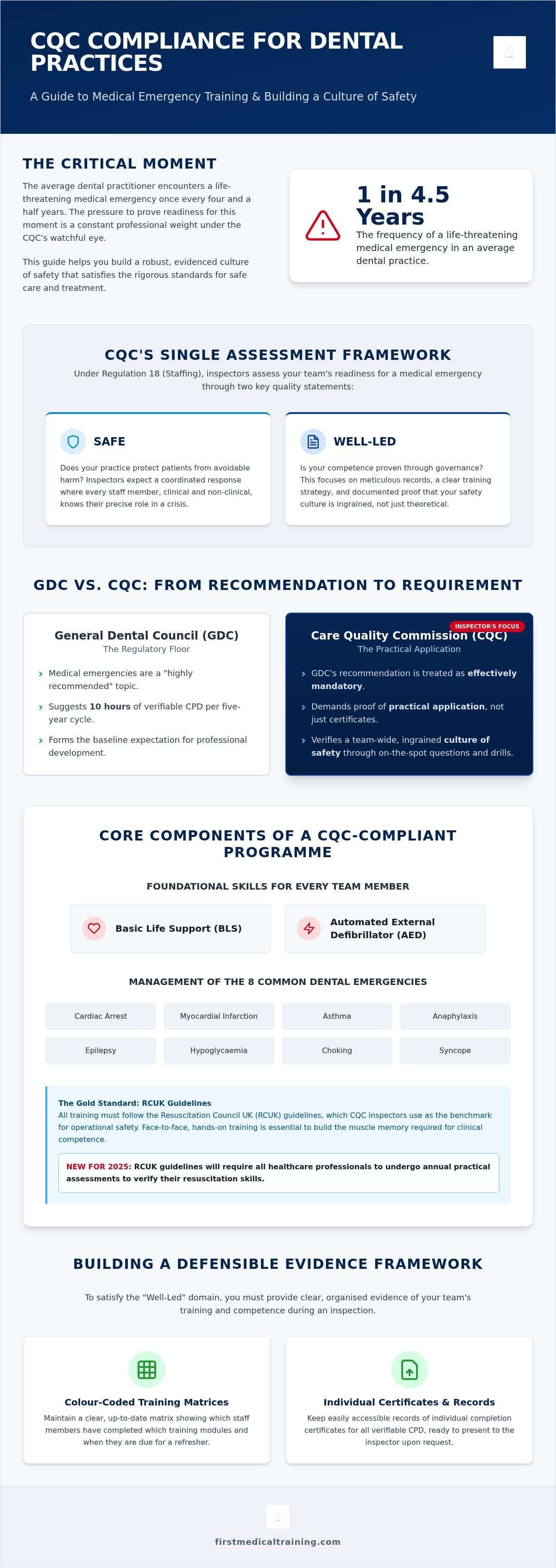
Would your team’s response to a sudden cardiac arrest in the waiting room survive the scrutiny of a CQC inspector the following morning? While the average dental practitioner encounters a life-threatening medical emergency once every four and a half years, the pressure to prove your readiness is a constant professional weight. It's understandable if you feel caught between GDC CPD requirements and the CQC’s complex Single Assessment Framework, worrying that a single gap in your training matrix might jeopardise your inspection outcome.
We know that organising whole-team sessions whilst managing a busy clinical diary is a significant logistical challenge. This guide is designed to help you master cqc compliance medical emergency training so you can build a robust, evidenced culture of safety. You'll gain the certainty that every staff member can act decisively in a crisis, supported by documentation that satisfies the rigorous 2026 standards for safe care and treatment.
We'll explore the transition from the old KLOEs to the current 34 Quality Statements, clarify the latest mandatory equipment lists, and show you how to implement the hands-on, scenario-based drills that inspectors now prioritise. This is your roadmap to a fully compliant practice where readiness is a daily reality rather than a paperwork exercise.
Key Takeaways
- Understand how the CQC Single Assessment Framework evaluates your practice under Regulation 18, specifically within the "Safe" and "Well-Led" domains.
- Identify the core components of cqc compliance medical emergency training, including practical BLS, AED skills, and the management of the eight most common dental crises.
- Learn how to construct a robust evidence framework using colour-coded training matrices and individual certificates to demonstrate team competence during inspections.
- Discover the logistical steps to organise effective, whole-team face-to-face training that ensures every staff member can act decisively in a medical emergency.
- Explore how specialised courses, such as Dental Immediate Life Support (ILS), provide the advanced training required for practices performing high-risk procedures.
Understanding CQC Compliance for Medical Emergency Training
Regulation 18 of the Health and Social Care Act 2008 (Regulated Activities) Regulations 2014 focuses on staffing. It demands that providers deploy enough suitably qualified, competent, and experienced staff to meet people’s needs safely. For a dental practice, this means your team must be prepared for a medical emergency at any moment. CQC inspectors primarily assess this readiness through two lenses: the "Safe" and "Well-Led" quality statements.
The "Safe" domain asks whether your practice protects patients from avoidable harm. If a patient collapses, the inspector expects to see a coordinated response where every staff member knows their role. The "Well-Led" domain focuses on governance. It's not enough to be competent; you must prove it through meticulous records and a clear training strategy. Whilst the CQC doesn't publish a specific syllabus, they expect you to follow the Resuscitation Council UK (RCUK) guidelines. This includes ensuring both clinical and non-clinical staff attend annual refresher sessions to keep their life-saving skills sharp.
The Distinctions Between GDC CPD and CQC Standards
The General Dental Council (GDC) categorises medical emergencies as a "highly recommended" topic, suggesting 10 hours of verifiable CPD per five-year cycle. However, for CQC inspectors, this recommendation is effectively mandatory. These GDC CPD requirements for medical emergencies serve as the regulatory floor. CQC compliance goes a step further by looking for the practical application of knowledge. An inspector might ask a receptionist where the oxygen is or ask a nurse to demonstrate how to use the AED. They aren't just checking your certificates; they're looking for a cqc compliance medical emergency training culture where safety is ingrained.
The Role of Resuscitation Council UK (RCUK) Guidelines
RCUK guidelines are the benchmark for emergency care in the UK. Inspectors use these standards to judge whether your practice is operationally safe. Face-to-face training is essential here because clinical competence cannot be gained through a screen. You need to physically handle the equipment and practise chest compressions on a manikin to build muscle memory. Effective 2025, RCUK guidelines require all healthcare professionals to undergo annual practical assessments to verify their resuscitation skills. This ensures that your cqc compliance medical emergency training remains current and effective.
Core Components of a CQC-Compliant Training Programme
A robust programme for cqc compliance medical emergency training must go beyond a simple tick-box exercise. It requires a structured approach that combines theoretical knowledge with practical, high-pressure application. At its foundation, every staff member must be proficient in Basic Life Support (BLS) and the use of an Automated External Defibrillator (AED). Because every second counts during a cardiac arrest, the CQC expects teams to demonstrate an immediate, coordinated response using the specific AED model located on their premises.
Your training should cover the management of the eight common medical emergencies identified by the British National Formulary and the Resuscitation Council UK. This includes cardiac arrest, myocardial infarction, asthma, anaphylaxis, epilepsy, hypoglycaemia, choking, and syncope. Effective training ensures that staff don't just recognise the symptoms but can also confidently administer the correct emergency drugs and oxygen at the required flow rates.
Managing Dental-Specific Emergency Scenarios
Emergencies often look different when a patient is reclined in a dental chair. Training must account for these unique environmental factors. For instance, syncope management is the most frequent event in dental practices, yet it can easily be mismanaged if the team isn't practised in rapid chair positioning and airway maintenance. Similarly, protocols for anaphylaxis and hypoglycaemia must be adapted to the clinical setting, ensuring that the emergency kit is accessible and that every team member knows their designated role. For airway obstructions, the inclusion of specialist equipment like the LifeVac anti-choking device can be a life-saving addition to your standard protocols.
Equipment and Drug Protocols
The CQC prioritises the availability and condition of your emergency kit. You must ensure your practice stocks the mandatory drugs, including Adrenaline 1:1000, Midazolam, and Glucagon, and that staff are trained in their specific administration routes. Following the latest CQC guidance, inspectors will check that your equipment, such as portable suction and bag-valve-masks, is not only present but fully functional.
We recommend using a dental practice emergency preparedness checklist to audit your inventory regularly. However, having the equipment is only half the battle. The most effective cqc compliance medical emergency training involves "in-situ" drills. These are practice runs held in your actual surgeries rather than a staff room. This tests your team's ability to communicate and move effectively in the real-world space where an emergency would occur. To ensure your team is fully prepared for their next inspection, consider booking a Medical Emergencies in a Dental Practice Course that focuses on these practical, hands-on skills.
Building a Defensible Evidence Framework for Inspections
Proving your readiness to a CQC inspector requires more than a folder of dusty certificates. You need a "defensible culture of competence" where evidence is organised, accessible, and meaningful. A central pillar of this is a live training matrix. By colour-coding staff progress; green for current, amber for upcoming renewals, and red for expired; you demonstrate proactive management. This visual tool allows you to identify gaps in your cqc compliance medical emergency training before they become a regulatory risk.
Your evidence framework should also include detailed logs of mock drills. Inspectors look for "reflective learning," which means you shouldn't just record that a drill happened. You should document what the team did well, where communication faltered, and what changes were made as a result. This creates a clear audit trail, linking your training efforts directly to your incident reporting systems and safety protocols, such as the CQC guidance on emergency drugs and equipment.
Competency Assessments vs. Attendance Certificates
There's a critical difference between an attendance certificate and a certificate of competence. An inspector wants to see that a staff member can actually perform life-saving manoeuvres, not just that they sat through a presentation. Individual certificates are superior to group ones because they link specific skills to specific professionals. Practical assessments provided by external, accredited partners offer a higher level of assurance than internal peer-led sessions, as they provide an unbiased validation of your team's actual abilities in a crisis.
Staff Induction and Ongoing Supervision
Compliance begins on day one. You shouldn't wait for the next annual team session to train a new hire; medical emergency protocols must be a priority during their first week of employment. This ensures that even the newest member of the team knows the location of the oxygen and the AED. Beyond induction, use regular staff meetings to reinforce these skills. Whilst annual whole-team sessions set the standard, monthly "micro-drills" or equipment checks keep the knowledge fresh and ensure your cqc compliance medical emergency training remains a living part of your practice's daily operations.
Organising Effective Refresher Training for Dental Teams
Maintaining high standards requires a methodical approach to annual refreshers. To achieve full cqc compliance medical emergency training, you should follow a five-step workflow that ensures no staff member is left behind. First, conduct a training needs analysis. This identifies the specific requirements of clinical staff versus admin teams. Second, schedule a whole-team face-to-face session. This ensures everyone understands their specific role when a crisis occurs. Third, integrate practical skills such as AED operation and airway management. Fourth, update your training matrix and evidence folder immediately after the session to reflect current competencies. Finally, plan quarterly mock drills. These short, focused exercises maintain muscle memory between your larger annual sessions.
Why Face-to-Face Training is Non-Negotiable
Whilst online modules are useful for theoretical updates, they cannot replace the value of hands-on practice. Clinical staff must physically demonstrate their ability to perform high-quality chest compressions and ventilations. The Resuscitation Council UK (RCUK) is clear: resuscitation skills must be assessed practically by a competent trainer to ensure clinical safety. On-site training also allows your team to test the actual emergency equipment they'll use in a real event. You don't want the first time a nurse opens your specific bag-valve-mask to be during a genuine emergency. Expert-led sessions provide the reassurance that your equipment is fit for purpose and your team knows exactly where it's stored.
Training for Non-Clinical Staff (Receptionists and Admin)
A common mistake is focusing cqc compliance medical emergency training solely on the clinical team. However, receptionists are often the first to witness a patient collapse in the waiting area. They play a vital role in cardiac arrest management, primarily by coordinating the emergency services and directing paramedics to the correct surgery. Including them in annual training builds their confidence to act under pressure. For broader practice safety, you might also consider an first aid at work for dental practices qualification for your admin lead. This ensures you have a designated first aider for non-clinical incidents, such as a slip or fall in the reception area.
Ready to ensure your team meets the highest regulatory standards? Book our accredited Medical Emergencies in a Dental Practice Course to secure your 2026 compliance.
Securing Compliance with First Medical Training’s Expert Courses
Choosing a training provider is a critical decision for any dental practice manager. You need a partner who understands that cqc compliance medical emergency training is about more than just a certificate; it's about the safety of your patients and the confidence of your staff. Since our foundation in 2006, First Medical Training has provided 20 years of specialised expertise to the dental sector. We act as a bridge between complex regulatory requirements and the practical skills your team needs on the ground. Our sessions are specifically tailored to satisfy both CQC inspectors and GDC CPD requirements, ensuring your practice remains operationally safe and fully evidenced.
The Medical Emergencies in a Dental Practice Course
Our flagship Medical Emergencies in a Dental Practice Course is the gold standard for team-wide readiness. The curriculum covers the essential pillars of emergency care, including high-quality BLS, AED operation, and the administration of emergency drugs. We focus on the eight major clinical scenarios your team is most likely to encounter. By delivering this training face-to-face, we provide the verifiable CPD required for the whole team whilst building the muscle memory that only physical practice can offer. This course ensures that your evidence folder is inspection-ready with individual certificates of competence for every attendee.
Advanced Compliance: Dental ILS and Mental Health
Compliance requirements often escalate based on the treatments you provide. Practices offering conscious sedation or complex surgical procedures require our Dental Immediate Life Support (ILS) Training. This advanced course focuses on airway management and circulatory support, providing a higher level of clinical assurance for high-risk environments. We also recognise that CQC standards in 2026 increasingly focus on staff wellbeing and the "Well-Led" domain. Our Mental Health First Aid for Dental Practices helps you meet these expectations by supporting the psychological safety of your team. To provide a truly comprehensive safety strategy, we also supply the LifeVac Anti-Choking Device, giving you an additional layer of protection against one of the most stressful emergencies a practice can face.
Secure Your Practice's Future with Clinical Readiness
Achieving a "Safe" and "Well-Led" rating in 2026 requires more than a casual approach to regulatory standards. It demands a defensible culture of competence where every team member, from the clinical lead to the reception staff, is prepared to act decisively. By integrating structured mock drills and maintaining a live, colour-coded training matrix, you transform your evidence folder from a static record into a dynamic proof of safety.
Face-to-face cqc compliance medical emergency training remains the only way to truly verify the practical skills required by the Resuscitation Council UK. At First Medical Training, we've been the trusted partner for dental surgeries nationwide since 2006. Our specialist trainers bring real-world clinical experience to every session, ensuring your team receives accredited education that satisfies both the CQC and the GDC.
Don't leave your next inspection outcome to chance. Book your CQC-compliant Medical Emergencies in a Dental Practice Course today and gain the peace of mind that comes with total clinical readiness. Your team is your greatest asset in a crisis; give them the tools to excel.
Frequently Asked Questions
Is annual medical emergency training mandatory for CQC compliance?
Annual training is the industry standard for cqc compliance medical emergency training. Although the GDC suggests ten hours of verifiable CPD every five years, the CQC expects to see evidence of annual hands-on refreshers. This ensures that skills remain current and that the team can respond effectively to a crisis. Failing to provide evidence of yearly practical sessions often leads to a "Requires Improvement" rating under the "Safe" key question.
Can dental teams complete medical emergency training online?
Clinical staff cannot rely solely on online modules for their resuscitation skills. The Resuscitation Council UK and the CQC require face-to-face, practical assessments to verify competence in Basic Life Support (BLS) and AED use. Whilst online learning is suitable for theoretical updates, it doesn't build the muscle memory needed for physical manoeuvres. Practical training in your own surgery also allows you to test your specific emergency equipment in its actual storage location.
What medical emergency drugs must be kept in a dental practice?
UK dental practices must maintain a specific kit defined by the British National Formulary. This mandatory list includes Adrenaline (1:1000), Aspirin (300mg), Glucagon, Glyceryl Trinitrate (GTN) spray, Salbutamol inhalers, and Midazolam. In addition to these drugs, you must stock portable oxygen, a bag-valve-mask, and an Automated External Defibrillator (AED). Regular audits are essential to ensure these items remain within their expiry dates and are ready for immediate use.
Do dental receptionists need BLS training for CQC compliance?
Yes, receptionists and administrative staff should be included in your annual cqc compliance medical emergency training. The CQC advocates for a whole-team approach to safety because emergencies often occur in non-clinical areas like the waiting room. A receptionist who can perform BLS and coordinate emergency services is a vital link in the chain of survival. Including them in drills ensures a seamless transition of care when clinical staff arrive to assist.
How long should medical emergency training records be kept?
You should retain medical emergency training records for at least five years to satisfy both GDC and CQC requirements. The GDC mandates that you keep verifiable CPD records for the duration of your five-year cycle plus an additional five years. For CQC inspections, having a clear, historical audit trail demonstrates a long-term commitment to staff development and patient safety. We recommend storing these digitally within your central training matrix for easy access during visits.
What happens if a dental practice fails a CQC inspection on training?
Failing to demonstrate adequate training can lead to significant regulatory action. The CQC may issue a Requirement Notice or a Warning Notice under Regulation 12 (Safe Care and Treatment) or Regulation 17 (Good Governance). This often results in a lower overall rating for your practice, which is published on the CQC website. You'll be required to provide a detailed action plan outlining how you'll rectify the training gaps and ensure future compliance.
Does the GDC require medical emergency training every year?
The GDC strongly recommends that all dental professionals complete at least two hours of medical emergency CPD every year. Whilst this is technically a recommendation for your professional registration, the CQC views it as a mandatory requirement for practice safety. In 2026, inspectors expect to see that every staff member has met this annual benchmark. Adhering to this schedule ensures your practice remains compliant with the Single Assessment Framework's "Safe" and "Well-Led" domains.
What is the difference between BLS and ILS for dental professionals?
BLS (Basic Life Support) focuses on the core skills of cardiopulmonary resuscitation and the use of an AED. It's the foundational level of training required for all dental staff. Dental Immediate Life Support (ILS) is an advanced course that includes airway management and circulatory support techniques. ILS is typically required for clinical teams performing high-risk procedures, such as conscious sedation, where a higher level of intervention might be necessary before paramedics arrive.